03 · Gear that actually matters
Buy a pit you will light.
A thick used offset beats a thin new one. A kettle teaches fire. A pellet cooker holds a number. None of them will save dirty smoke.
Comparison
| Cooker | Fuel | Control | Smoke | Capacity | Cost | Best first cook |
|---|---|---|---|---|---|---|
| Offset | Splits | Manual | Strong | Large | $$–$$$$ | Shoulder |
| Vertical water | Charcoal | Vents | Medium | Medium | $–$$ | Ribs |
| Pellet | Pellets | Digital | Light | Medium–large | $$–$$$ | Chicken |
| Kamado | Lump | Tiny vents | Medium | Small–medium | $$–$$$$ | Chicken |
| Kettle | Charcoal | Zones | Medium | Small | $ | Two-zone bird |
| Drum / UDS | Charcoal | Intakes | Strong | Medium | $–$$ | Shoulder |
| Brick pit | Coals | Distance | Strong | Huge | $$+ | Shoulders |
| Gas + chips | Gas/chips | Knobs | Light | Small | $–$$ | Chicken |
| Open grate | Coals | Crank | Medium | Medium | $$–$$$ | Tri-tip |
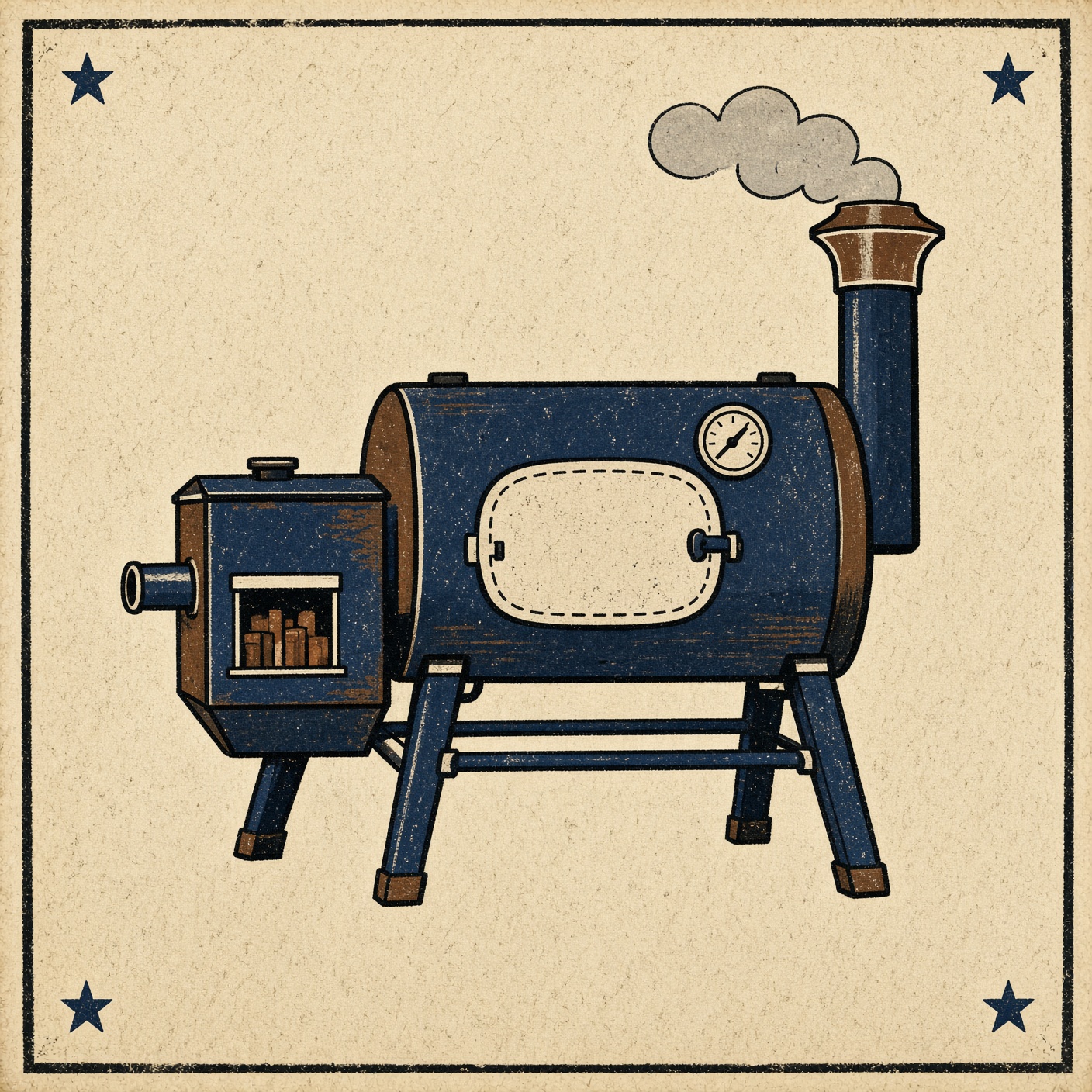
strong smoke
Offset / stick burner
AdvancedFire craft or a grind.A horizontal chamber with a firebox welded to one end and a chimney at the other. You burn splits. Heat and smoke travel the length of the grate.
Fire lives in the box. Intake vents feed oxygen. The stack pulls. Thin blue smoke should wash over the meat and leave. Hot spots live near the firebox; rotate meat.
| Best meats | Brisket, beef ribs, anything that wants a long clean oak fire. |
| Worst use | A Tuesday chicken for two. You will spend more time on the fire than on dinner. |
| Buying | Look at steel thickness (1/4 in / 6 mm is a real pit; thin metal fights you). A well-fitted firebox door. A chimney sized to pull. Cheap offsets leak and run dirty. A used thick one beats a new thin one. |
| First cook | Pork shoulder, not brisket |
Setup
- Level the pit. Chimney end can sit a hair higher so grease runs to a bucket, not the firebox.
- Build a coal bed with splits or a charcoal starter, then feed splits on the coal, not on cold steel.
- Open intake and exhaust until you have thin blue. Then pinch the intake to hold 250–275°F (121–135°C).
- Put a water pan only if the pit runs harsh and dry. Many offsets do not need one.
- Park the thick end of a brisket toward the firebox.

medium smoke
Vertical water smoker
WeekendAn afternoon. One wrap call.Stacked drums: charcoal at the bottom, a water pan in the middle, grates above, a lid with vents. The Weber Smokey Mountain shape is the type, not a brand requirement.
Heat rises through water vapor. The pan buffers spikes. Exhaust vents on the lid do most of the steering once the bottom vents are set.
| Best meats | Ribs, shoulder, a first brisket. Overnight minion-method cooks. |
| Worst use | Searing steaks. High-heat pizza. Anything that wants a hard crust from close fire. |
| Buying | Fit of the lid matters. A decent thermometer hole. Capacity: 18 in (46 cm) for a household, 22 in (56 cm) if you feed a crowd. Buy a separate probe; the lid gauge lies. |
| First cook | Saturday ribs |
Setup
- Minion method: unlit charcoal in the ring, lit coals in a well on one side, a few wood chunks on the lit edge.
- Fill the water pan with hot water (hot so you do not stall the pit getting it up).
- Set bottom vents mostly closed, top vent open. Chase with the bottom, not the top.
- Do not lift the lid to peek. You are dumping heat and adding time.

light smoke
Pellet cooker
BeginnerOne session. Forgiving.A hopper of compressed wood pellets, an auger, a fire pot, a fan, a controller. You set a temperature.
The controller pulses pellets and air to hold a number. Smoke is cleaner and milder than a stick burner. Many models run hotter and cleaner above 300°F (149°C) — less smoke flavor there.
| Best meats | Weeknight chicken, first brisket if fire management is the blocker, overnight unattended cooks. |
| Worst use | People who wanted a campfire in a steel tube. Pellet smoke will not taste like an offset. That is not a defect. It is a different tool. |
| Buying | A probe you trust, a hopper that holds enough for the cook, and a cover. PID controllers hold tighter. Keep pellets dry. Wet pellets turn to sawdust and stall the auger. |
| First cook | Thursday chicken or a shoulder |
Setup
- Start on the smoke or 180–200°F (82–93°C) setting for 45 minutes if you want more smoke on poultry or ribs, then raise to cook temp. For brisket, many just set 250°F (121°C) and go.
- Use a water pan if the cooker runs dry. Not all do.
- Point the thick end toward the hotter side (usually the fire pot).
- Have a backup plan for power loss. This cooker dies when the outlet dies.

medium smoke
Kamado
WeekendAn afternoon. One wrap call.A thick ceramic (or insulated steel) egg. Charcoal in the bottom, a grate, a felt-gasket lid, daisy-wheel top vent.
Mass holds temperature. Small vent moves make big changes. Once it is stable, it stays. Overshoot is the beginner tax — you will wait an hour to come back down.
| Best meats | Shoulder, chicken, steaks (it sears), overnight low cooks. |
| Worst use | Huge packers on a small grate. High-volume restaurant service. Impatient vent-fiddling. |
| Buying | Gasket condition, a reliable band, a plate setter / heat deflector for indirect. Crack a ceramic cooker once and you own a planter. |
| First cook | Whole chicken |
Setup
- Light a small well of charcoal, not the whole firebox.
- Install the deflector for low-and-slow. Leave it out for direct.
- Top vent open to start, then pinch both vents as you approach target. Wait 15 minutes after each change.
- A drip pan on the deflector saves ceramic and catches fat.

medium smoke
Kettle, two-zone
BeginnerOne session. Forgiving.A round bowl, a lid, charcoal on a grate. The most honest cooker in America. Two-zone means fire on one side, food on the other.
Bank coals left. Put a drip pan right. Lid on, vent over the food so smoke pulls across. You are grilling and smoking with the same bowl.
| Best meats | Weeknight chicken, sausage, a single rack of ribs, anything under 4 hours. |
| Worst use | Overnight brisket. You will be feeding charcoal in the dark. Possible. Not kind. |
| Buying | A tight lid, working vents, a cheap charcoal chimney. You do not need the deluxe model to learn fire. |
| First cook | Thursday Two-Zone Bird |
Setup
- Fill a chimney. When the top coals ash over, dump them on one side.
- Add a chunk or two of wood on the coals, not a log that smothers them.
- Drip pan with a cup of water on the cool side.
- Meat on the cool side. Lid on. Top vent over the meat, half to three-quarters open.
- Add 8–10 coals every 45–60 minutes for long cooks.

strong smoke
Drum / UDS
WeekendAn afternoon. One wrap call.An upright 55-gallon drum. Charcoal basket at the bottom. Grate in the middle or hanging. Intake at the foot, exhaust on the lid. Ugly. Effective.
Mostly direct radiant heat from the basket, plus smoke. Runs hotter and faster than an offset. Water pan optional; many drums run dry and still juicy because the cook is shorter.
| Best meats | Shoulder, ribs, sausage, chicken. Brisket in 6–8 hours if you like a darker, faster bark. |
| Worst use | Delicate fish. Anything that needs a cool corner. |
| Buying | Food-safe drum (new or lined, not a mystery chemical barrel). A sealed lid. A charcoal basket that lets ash fall. Weld quality on the intakes. |
| First cook | Pork shoulder |
Setup
- Light a full basket, then shut the lid and pinch intakes to settle at 275°F (135°C).
- Hang or grate the meat above, not in the coals.
- Do not over-smoke. Drum smoke is punchy. One or two chunks is enough.
medium smoke
Horizontal barrel
WeekendAn afternoon. One wrap call.A drum laid on its side with a fire at one end. Poor cousin of the offset. Same logic, usually thinner metal.
Same as a small offset. Leaks are common. Manage them with gasket, not with prayer.
| Best meats | Ribs and shoulder if the barrel seals. |
| Worst use | Windy winter brisket in a leaky drum. |
| Buying | If you can buy a real offset, do. A tight homemade barrel still teaches fire. |
| First cook | Ribs |
Setup
- Fire at one end, chimney at the other. Same vent logic as an offset.
- Seal leaks you can see. Smoke should exit the stack, not the door seam.

strong smoke
Brick / cinder-block pit
AdvancedFire craft or a grind.A box of masonry, a steel grate, a fire of coals or logs. Church pits, backyard blocks, old-school hog boxes.
Mass. The walls eat heat for an hour, then give it back all night. You shovel coals under or to the side. Air is whatever you built into the walls.
| Best meats | Hog principles, shoulders by the dozen, community cooks. |
| Worst use | A single weeknight chicken. You do not light a masonry pit for two people. |
| Buying | Firebrick or hard brick for the fire side. Cinder block is fine for walls if you line the fire. Steel grate thick enough not to warp. A roof helps. Local code matters — check it. |
| First cook | Several pork shoulders, not a hog |
Setup
- Build the fire early. Masonry is slow to come up.
- Bank coals to one side or in a firebox end so fat does not rain into open flame.
- You are cooking on radiant heat and smoke, not in an oven. Flip and rotate.

light smoke
Gas or electric + chips
BeginnerOne session. Forgiving.A gas grill or electric smoker with a box or pouch of wood chips. Not a stick burner. Still makes dinner.
Burners or an element hold a number. Smoke is a side channel. Use two-zone on gas: one burner on, food on the other, chip box over the lit burner.
| Best meats | Weeknight chicken, sausage, a first rib rack when charcoal is not an option. |
| Worst use | A 14-hour brisket you wanted to taste like post oak. You will get a roast with a hint. That can still be good. |
| Buying | A tight lid. A stainless chip box. Skip soaked chips — they steam, then they smoke. Dry chips in a box smoke cleaner. |
| First cook | Thursday Two-Zone Bird |
Setup
- Light one side. Chip box on that side. Food on the other.
- Lid down. 300°F (149°C) is a honest gas-grill smoke temp.
- Refill chips when the wisp dies. Do not drown them.

medium smoke
Santa Maria / open grate
WeekendAn afternoon. One wrap call.A grate on a crank over a trough of coals. No lid. Distance is your damper.
Live fire. Raise the grate to cool, lower to sear. Wind is a real ingredient.
| Best meats | Tri-tip, chicken halves, sausages, anything that wants a crust in under two hours. |
| Worst use | Low-and-slow brisket. No chamber, no overnight. |
| Buying | A crank that locks. A grate you can lift with gloves. Red oak if you can find it. |
| First cook | Tri-tip or chicken halves |
Setup
- Burn splits down to coals in the trough. You cook over coals, not flames.
- Season the meat. Crank to a working height. Flip on a schedule, not a whim.
- Have a cool zone at one end of the grate.